
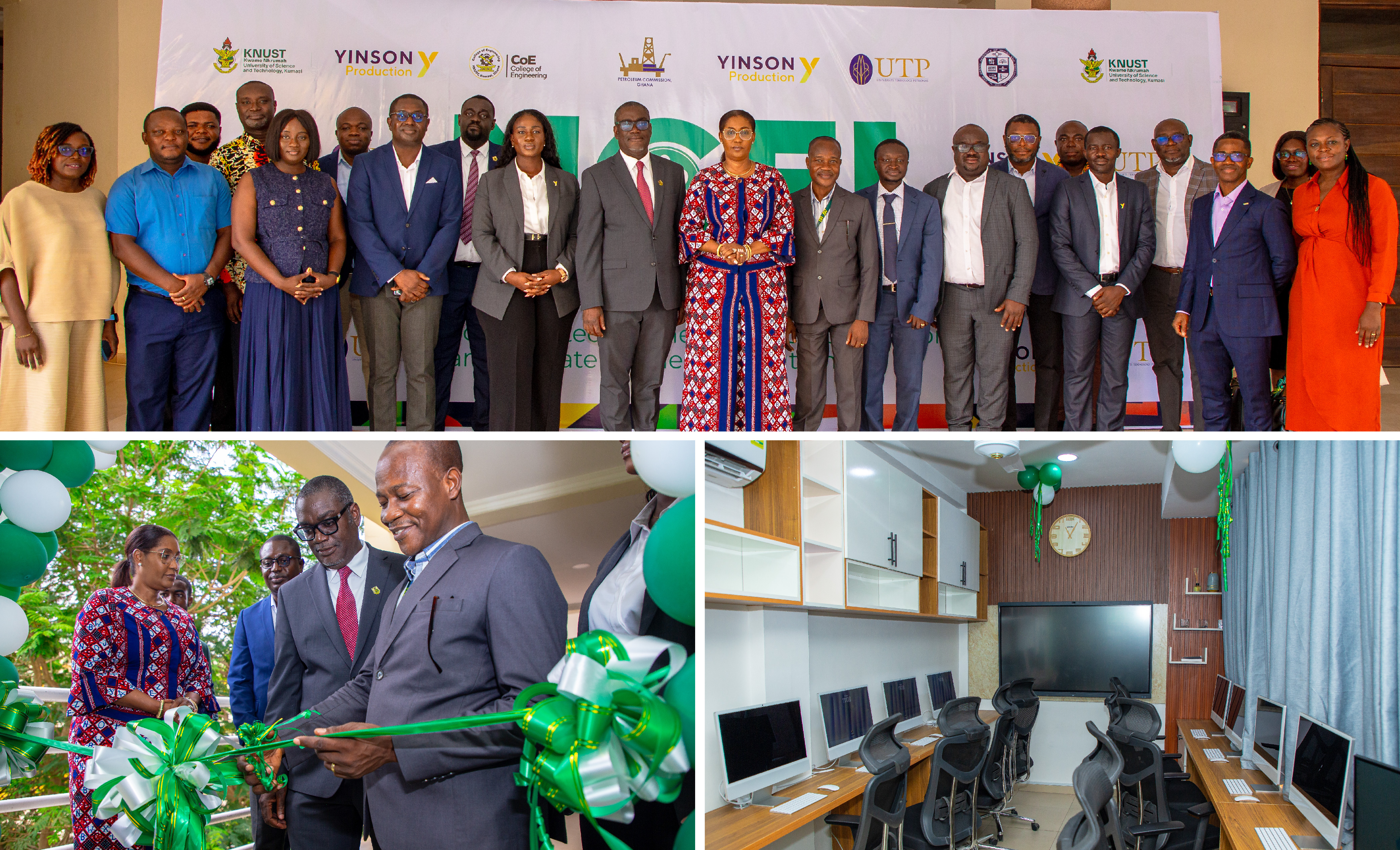
The Kwame Nkrumah University of Science and Technology (KNUST), Yinson Production West Africa Limited (Yinson), and the Petroleum Commission (PC) have commissioned the Net-Zero Carbon Emission Lab (NCEL), Ghana’s first specialised centre dedicated to scientific carbon measurement, emissions modelling, advanced decarbonisation research and industry-focused training.
The lab, situated at the College of Engineering, forms part of the Net-Zero Carbon Emissions Project (NCEP), a five-year research and development partnership signed on 12 June 2025 to harmonise Ghana’s greenhouse gas (GHG) emissions data into a single interactive national map and conduct a full carbon-intensity assessment of the oil and gas sector.
Yinson funded the establishment of the facility with an investment of about US$350,000, with the first tranche released immediately after the inception report and implementation plan were submitted.
Prof. Kwabena Biritwum Nyarko, Provost of the College of Engineering, said the initiative reflects the University’s commitment to producing industry-ready graduates while contributing scientific leadership to national development.
“Our work with industry is very relevant. We design our curriculum to respond to the needs of industry. They provide opportunities for internships and vacation training, ensuring our students are ready for the jobs of today and tomorrow,” he said.
“We also work with them in innovation and entrepreneurship, so students can create jobs when they finish.”
Representing the Vice-Chancellor, Prof. Samuel Asare-Nkansah said the NCEL addresses a critical national gap: the absence of a consolidated, scientifically robust dataset on the country’s current emissions profile.
“Although Ghana is committed under the Paris Agreement to decarbonisation and net-zero emissions, we lack a unified emissions baseline. The NCEL is a clear demonstration of commitment to collaboration and knowledge-transfer partnerships between academia and industry,” he said.
He added that the project will support evidence-based climate policy, strengthen monitoring capability and propose mitigation strategies for industry, especially the oil and gas sector.
Naa Opoku-Agyeman, Managing Director of Yinson Ghana, said the company views the project as part of its long-term commitment to capacity development.
“At Yinson we are committed to this journey, investing in education, building knowledge, empowering talent and creating a future where sustainability drives progress. This industry academia NCEP partnership, the first of its kind in Ghana aligns deeply with Yinson’s 30 by 30 sustainability goals specifically in the areas of climate action and education,” she said.
CEO of the Petroleum Commission, Victoria Emeafa Hardcastle, described the commissioning as “a transformative journey and a forward-looking commitment to sustainability, innovation and responsible resource development.”
The Principal Investigator of the project and Senior Lecturer in the Department of Petroleum Engineering, Dr. Yen Adams Sokama-Neuyam, stated that the team remains firmly committed to delivering cutting-edge research and high-level advisory services to support government policy and industrial innovation to advance national climate action.
He noted that the project stands as a powerful testament to the local oil and gas industry’s commitment to bold net-zero ambitions, demonstrated through strategic investment in in-country research and development.
The NCEL houses an ultra-modern workspace that doubles as a training studio, with high-performance computing for AI-driven analytics and simulations, modern research workstations, smart presentation systems, energy-efficient infrastructure and enhanced security systems to safeguard equipment and project data.
When fully operational, the lab will function as a dual-purpose facility, a research hub and an industry training centre, and a living laboratory for emerging technologies including Carbon Capture, Utilization and Storage (CCUS) for oil and gas decarbonisation.
In just six months, the project has assembled an interdisciplinary team, appointed a project manager and communications officer, recruited six funded MPhil students, and advanced stakeholder engagements across national institutions.
Unlike typical project-based labs that stall after seed funding, NCEL is structured to become self-sustaining. NCEL will sustain its operations through a mix of revenue-generating services, including professional training and certification, strategic advisory support, carbon credit validation and verification, and specialised laboratory services.


